
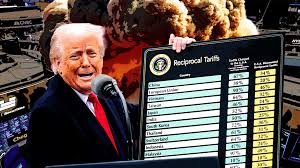
Consumers and American Manufacturers Alike Tout Trump Tariffs for Growing Economic Pain
WASHINGTON-- Jay Allen, an Arkansas manufacturer and supporter of President Donald Trump, cast his vote believing the Republican’s policies would cut taxes, ease regulations, and ultimately benefit businesses like his. Instead, he says the tariffs at the center of Trump’s economic agenda have created serious challenges for his company.
Allen owns Allen Engineering Corp., a northeast Arkansas firm that produces industrial equipment used in concrete installation and paving. The company relies on imported components such as engines, steel, gearboxes, and clutches—many of which have become significantly more expensive due to tariffs. Those higher costs have cut into margins on products like power trowels, which can sell for as much as $100,000.
His experience reflects a broader trend among U.S. manufacturers grappling with the impact of tariffs that were intended to strengthen domestic industry. Rather than spurring growth, many companies report financial strain, a situation that could worsen as the administration works to replace emergency import taxes struck down by the Supreme Court earlier this year.
Allen said his company operated at a loss in 2025 due to tariff-related costs. Its workforce has shrunk from a peak of 205 employees to 140. To stay afloat, he has raised prices between 8% and 10%, a move that risks dampening demand.
“What’s really sad is the unintended consequences of his tariffs are hurting manufacturing in our country,” Allen said. “Unfortunately, the working-class people are getting squeezed.”
Trump has argued that tariffs would encourage companies to relocate production to the United States and generate revenue to reduce federal deficits. However, those outcomes have yet to materialize. Manufacturing employment has declined, with 98,000 jobs lost during Trump’s first full year back in office. At the same time, U.S. companies are seeking more than $130 billion in tariff refunds through legal challenges, while federal deficits are projected to increase over the coming decade.
The White House maintains that the policy’s benefits will take time to emerge. Officials point to strong construction spending, increased hiring tied to factory projects, and rising productivity in the manufacturing sector as signs of a potential rebound.
“It takes time to get production online, and therefore it will be some more time before we fully materialize the benefits of the president’s policies,” said Pierre Yared, acting chairman of the White House Council of Economic Advisers.
Some of the gains cited by the administration, however, appear linked to initiatives launched under former President Joe Biden. Factory construction spending began rising sharply in 2022 following passage of the CHIPS and Science Act, which included major subsidies for semiconductor manufacturing. According to Skanda Amarnath of Employ America, those incentives drove a surge in spending on manufacturing facilities.
While construction activity remains relatively elevated, it has slowed during Trump’s presidency and is largely sustained by ongoing projects in states such as Arizona, Texas, and Idaho that were initiated under Biden. Amarnath noted that while certain sectors, like pharmaceuticals, show signs of expansion, there is no broad-based manufacturing boom tied to tariffs.
“You don’t get the sense that there is this new manufacturing renaissance underway,” he said.
Trump has taken more than 50 tariff-related actions through orders and proclamations, creating an unpredictable policy environment. Frequent changes, exemptions, and legal disputes—combined with the administration’s use of executive authority rather than congressional approval—have made long-term planning difficult, particularly for smaller firms.
Allen Engineering, for example, imports 75-horsepower diesel engines from Germany. Producing those engines domestically would require an estimated $20 million investment, a risk Allen says is hard to justify amid policy uncertainty.
“Are engine-makers going to spend that kind of money to move production from Germany to the U.S. when they don’t know what the landscape is going to be in three years?” Allen said.
Economists say the timeline for any potential benefits is long even under favorable conditions. Joseph Steinberg of the University of Toronto said research suggests it could take a decade for manufacturing employment to surpass pre-tariff levels. Given the current instability in trade policy, he added, that best-case scenario appears unlikely.
Smaller manufacturers are particularly vulnerable. Census Bureau data shows about 98% of U.S. manufacturing firms employ fewer than 200 workers, leaving them without the resources or influence to mitigate tariff impacts in the way large corporations like Apple, General Motors, or Ford can.
Industry groups have raised additional concerns. The Association of Equipment Manufacturers reports that the United States continues to lag behind China in global manufacturing share and has called for targeted tax credits and tariff relief on materials and components not readily available domestically.
Steel tariffs, in particular, have drawn criticism. First imposed last year and later increased to 50%, they have raised costs for companies that rely on domestic steel. Glen Calder, president of South Carolina-based Calder Brothers, said prices jumped sharply even before the tariffs formally took effect.
“My steel pricing jumped 25% two weeks before the tariffs went into effect for domestic steel,” Calder said. “The market price just jumped. It has stayed elevated.”
A central aim of Trump’s trade strategy has been to counter China’s manufacturing dominance. However, the U.S. manufacturing trade deficit widened last year, while China’s global trade surplus reached a record $1.2 trillion.
Critics argue the approach has been undermined by a lack of international coordination. Lori Wallach of the American Economic Liberties Project said the administration has largely bypassed Congress and failed to build coalitions with allies to address issues like labor abuses, subsidies, and currency manipulation.
“The general revulsion of this administration to international cooperation means they’re trying to do it alone,” Wallach said.
For manufacturers like Allen, the uncertainty remains the biggest obstacle. Without a clear and consistent trade policy, he said, companies are left to navigate rising costs and difficult investment decisions with little assurance about the future.