
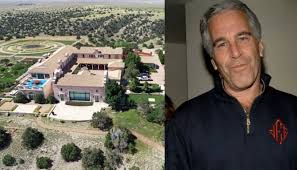
Darkest Horrors Yet May Come to Light as Epstein's Zorro Ranch Secrets are Revealed
SANTA FE, NEW MEXICO-- For years, Jeffrey Epstein’s Zorro Ranch in the high desert south of Santa Fe drew comparatively little scrutiny, emerging as a conspicuous gap in both extensive media coverage of his crimes and in law enforcement investigations.
That relative silence is beginning to erode.
In a recent episode of 60 Minutes Australia, U.S. Rep. Melanie Stansbury of New Mexico cited testimony from an alleged victim who described being invited to the ranch and witnessing “multiple young men” sexually assaulted after he himself had been drugged. The account was among several aired in the documentary as state authorities continue to advance a reopened investigation into alleged abuse at the secluded property.
New Mexico officials are now working to determine how many victims — including local women and girls — may have been targeted at the ranch, amid a wave of new allegations. Previously, only one known victim had been identified as a state resident. For years, speculation persisted that Epstein used the property’s isolation to conceal elements of his sex-trafficking operation. Reports, never substantiated, also circulated that he had contemplated using the ranch as part of a scheme to father children with multiple women in pursuit of eugenics-based aims.
Among the most troubling material to surface in recently released case files is a message included in Department of Justice records from an individual claiming to be a former ranch employee. The message alleged that two foreign girls died during violent sexual encounters at the property and were buried in nearby hills. The sender offered to exchange purportedly incriminating recordings involving minors for cryptocurrency. Authorities have not publicly confirmed the claims.
Momentum to revisit the ranch’s history has grown. Last month, New Mexico lawmakers unanimously approved the creation of a bipartisan “Truth Commission” tasked with examining allegations tied to the property. Shortly afterward, the state’s attorney general announced the reopening of an investigation that had been closed shortly before Epstein’s 2019 death in a Manhattan jail.
Newly unsealed records in 2026 also disclosed that the ranch was sold in 2023 to Don Huffines, a Dallas real estate developer and former Texas state senator. Huffines has since renamed the property San Rafael Ranch and said he intends to transform it into a Christian retreat. He has pledged cooperation with law enforcement, though investigators acknowledge that the passage of time and change in ownership may complicate efforts to recover physical evidence.
State Rep. Marianna Anaya, a Democrat and a leading figure on the Truth Commission, said the inquiry is unfolding against a broader backdrop of longstanding investigative gaps in New Mexico, particularly involving marginalized communities.
“New Mexico is often overlooked,” Anaya said, pointing to the state’s high rates of missing and murdered Indigenous persons and what advocates describe as persistent deficiencies in data collection and law enforcement response. “We need to understand not only what happened to those brought here, but also to the people from our own communities.”
According to the New Mexico Department of Indian Affairs, limited data and inconsistent investigative follow-through have contributed to an environment in which perpetrators may believe they can act with impunity.
Anaya said previously sealed FBI materials and past interviews with Epstein are now helping to clarify why he acquired the ranch in 1993. In some accounts, Epstein pointed to the property’s proximity to major scientific institutions, including Los Alamos National Laboratory and Sandia National Laboratories. He hosted gatherings there that drew academics and researchers, which investigators now view as part of a broader effort to lend legitimacy to his ideas.
Documents and testimony reviewed by authorities suggest Epstein had, as early as the early 2000s, discussed plans involving controlled reproduction and the use of technology to influence human genetics — concepts tied to discredited eugenics theories.
Efforts to investigate the ranch were previously curtailed. The New Mexico Department of Justice said a state-level inquiry ended in 2019 at the request of federal prosecutors in New York, who indicated they would take the lead. That investigation stalled following Epstein’s death.
State officials now say newly unsealed federal records justify renewed scrutiny. Investigators are seeking full access to unredacted case files and say they will coordinate with federal and local agencies, as well as the Truth Commission.
“For us, it’s about making sure every lead is pursued,” Anaya said.
The commission, which has subpoena power, is working alongside Rep. Andrea Romero and in coordination with Stansbury, who has access to federal records. Anaya said investigators believe additional witnesses may yet come forward and that enough evidence remains to reconstruct key events.
The renewed inquiry also revisits a 2019 tip sent to an Albuquerque radio host alleging that bodies had been buried on the ranch. Although the information was passed to the FBI at the time, state officials say there is limited indication the lead was aggressively pursued.
As investigators resume on-the-ground efforts, including forensic searches of the expansive property, Anaya said the goal is to bring long-delayed accountability.
“The desert has held these secrets for decades,” she said. “Our job is to make sure it doesn’t continue to do so.”