
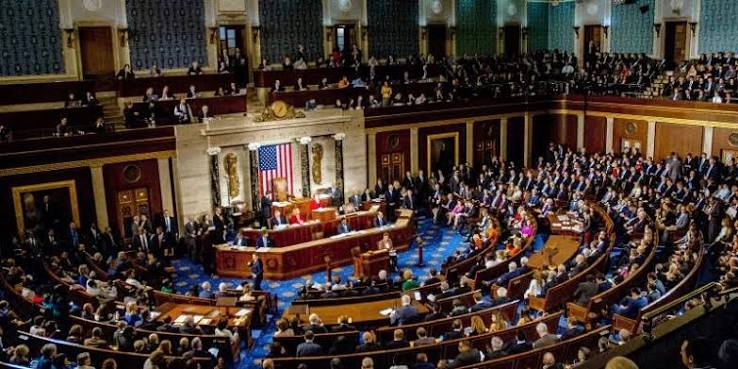
House OKs War Powers Resolution, Only to Have it Blocked by Senate
WASHINGTON-- Senate Republicans blocked an effort Thursday to force President Trump to withdraw U.S. troops from the war with Iran, as unease within the GOP grows over rising casualties, civilian deaths and the lack of a clear endgame to the conflict.
The Senate voted 47-49 against advancing a legally binding war powers resolution that would have required Trump to pull American forces from hostilities unless Congress authorizes military action. Sen. Susan Collins (R-Maine) joined Democrats in support of the measure, while Sen. John Fetterman (D-Pa.) was the lone Democrat to oppose it.
The vote comes as bipartisan concerns over the war continue to mount. Eighteen U.S. service members have been killed since fighting began, including three in the past week, while global shipping through the Strait of Hormuz has again ground to a halt following the collapse of a ceasefire between Washington and Tehran.
“This war has not been a success,” Sen. Rand Paul (R-Ky.), who missed Thursday's vote, told reporters Wednesday. “By any objective measure we're worse off than we were before the war.”
Other Republicans are increasingly questioning how long the conflict can continue. Sen. Jim Justice (R-W.Va.) called for an “off-ramp,” citing both military and civilian casualties.
“There’s got to be an off-ramp, that’s all there is to it,” Justice said.
The failed Senate vote came just hours after the House approved its own war powers resolution in a razor-thin 214-208 vote, with four Republicans breaking ranks to join Democrats in directing Trump to withdraw U.S. forces unless Congress formally authorizes the war.
Reps. Tom Barrett (R-Mich.), Warren Davidson (R-Ohio), Thomas Massie (R-Ky.) and Brian Fitzpatrick (R-Pa.) were the Republicans who voted for the measure.
Meanwhile, Trump escalated tensions Wednesday by threatening to retaliate against any Iranian attack on ships in the Strait of Hormuz by targeting civilian infrastructure around Tehran, including bridges and power plants.
Sen. Chris Van Hollen (D-Md.), who sponsored the Senate resolution, warned the conflict has entered a dangerous new phase.
“It’s the first resolution since shipping in the Strait of Hormuz has once again been ground to a halt,” Van Hollen said. “More civilians have been killed as well, and the United States and Iran are now deliberately targeting civilian infrastructure.”
Opponents of the measure argued withdrawing U.S. forces would embolden Tehran's leadership.
“This regime that we are fighting does not care about our partisan politics,” Sen. Tim Sheehy (R-Mont.), a former Navy SEAL, said on the Senate floor. “They want to kill all of us—and they don’t just say it, they actually do it.”
Thursday's vote marks the latest chapter in an increasingly bitter debate on Capitol Hill over Trump's war powers. Last month, Trump sharply criticized Republican senators who supported a separate measure aimed at ending the conflict during a tense meeting with GOP lawmakers, prompting some to reverse course on subsequent votes.
Unlike June's nonbinding resolution, Thursday's proposal carried the force of law and would have required Trump's signature if passed by both chambers.
For now, Senate Republicans have handed the president another victory—but growing bipartisan fractures suggest the debate over America's role in the Iran war is far from over.