
Netanyahu Defends Gaza War to UN, Escalating Public Clash With NYC Mayor Mamdani
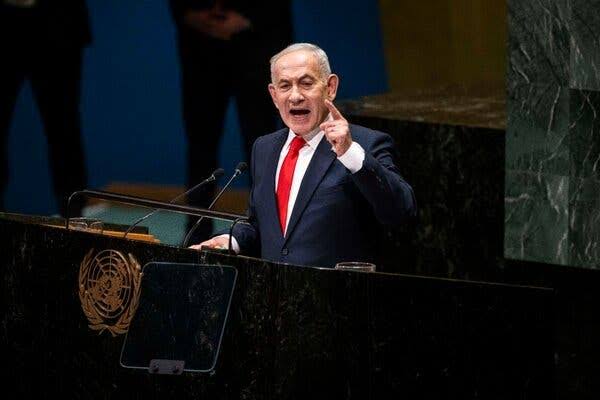
UNITED NATIONS — Israeli Prime Minister Benjamin Netanyahu used his address to the U.N. General Assembly on Thursday to defend Israel’s military campaigns, confront international critics and deliver a message aimed as much at voters back home as at the diplomats sitting before him.
The response inside the chamber was unmistakable. As Netanyahu approached the podium, hundreds of delegates left their seats and walked out in protest of Israel’s conduct of the war in Gaza, leaving large sections of the hall empty.
Netanyahu dismissed the departing diplomats and challenged those who remained to follow them.
“If there are any more moral cowards who haven’t left the hall, please do so now,” he said.
The walkout underscored the growing international criticism Israel has faced over the Gaza war, while Netanyahu’s speech reflected the political pressures he faces inside Israel ahead of next month’s elections.
Netanyahu accused Qatar and Turkey of promoting antisemitism and spreading what he described as misinformation about Israel. He also rejected allegations that Israel is committing genocide in Gaza, where Palestinian health officials say more than 75,000 people have been killed during the conflict.
“Accusing Israel of genocide is the greatest lie of the century,” Netanyahu said.
He also sought to minimize concerns over increasing violence by Israeli settlers against Palestinians in the occupied West Bank, describing those responsible as “a handful of young juvenile delinquents.”
Netanyahu devoted substantial attention to the Oct. 7, 2023, Hamas attack on Israel, when about 1,200 people were killed and roughly 250 others were taken hostage. The assault triggered Israel’s military campaign in Gaza.
He portrayed Israel’s subsequent military actions against Iran in similarly existential terms.
“If we hadn’t done it, we’d all be dead,” Netanyahu said.
He praised President Donald Trump for standing alongside Israel, describing the two countries as engaged in a “battle against the barbarians.”
Netanyahu also used the address to attack New York City Mayor Zohran Mamdani, accusing him of antisemitism and associating with Hamas. Mamdani has rejected accusations that he supports Hamas.
“You can’t silence me,” Netanyahu said, directing his remarks toward the mayor. “You can’t silence the truth.”
The confrontation with Mamdani had been building before Netanyahu arrived in New York. Mamdani previously said he would seek to have Netanyahu arrested over alleged crimes against humanity if the Israeli prime minister entered the city, though he later acknowledged that the mayor's office does not have jurisdiction to carry out such an arrest.
In a social media video ahead of the U.N. appearance, Netanyahu accused Mamdani of supporting Hamas and encouraging unrest directed at Jewish New Yorkers. Mamdani disputed those accusations.
When asked about Netanyahu's remarks Tuesday, Mamdani pointed instead to the death of an 11-year-old Palestinian boy who, he said, was killed by Israeli forces in an area designated as safe in Gaza.
Netanyahu's trip to New York came as Israel faces increasing international criticism over the humanitarian toll of its Gaza offensive. His schedule at the United Nations included relatively few diplomatic meetings, while Trump was focused on a planned summit with Chinese President Xi Jinping.
Netanyahu was expected to return to Israel shortly after his address to prepare for the Jewish holiday of Sukkot.
Before departing Israel, Netanyahu said he intended to use the U.N. podium to counter what he described as false allegations directed at Israel and its military.
The speech also served a domestic political purpose.
Netanyahu has presented himself to Israeli supporters as a leader willing to confront international pressure and defend the country regardless of criticism abroad. At the same time, he faces pressure from the Israeli right, where some critics have argued that his government has not taken sufficiently aggressive action against Iran and Iran-backed militant groups.
“The main reason that brings him to the UN General Assembly this time is the opportunity to talk, using the UN microphone, to his voters in Israel, in his polished English,” Ephraim Ganor, a political and strategic affairs analyst, wrote in the Israeli newspaper Ma’ariv.
Netanyahu has frequently incorporated visual aids and theatrical elements into his U.N. appearances, and Thursday's speech followed that pattern.
At one point, he held up a pager resembling the devices Israel used in 2024 in an operation that targeted Hezbollah members with explosives hidden inside communication devices.
“Remember the beepers?” Netanyahu said. “Well, I can tell you this, Hezbollah certainly remembers them.”
He also displayed a Starlink satellite internet device while addressing Iranians, suggesting that opponents of Iran's government could eventually use the technology to communicate freely.
Netanyahu's presentation included another familiar element: a large QR code displayed on his clothing. The code directed viewers to a website featuring video of the Hamas attack on Israel on Oct. 7, 2023.
Netanyahu has repeatedly used maps, props and other visual devices during his U.N. speeches.
In 2023, he presented maps depicting what he characterized as the expanding benefits of Israeli regional integration alongside what he described as the growing threat posed by Iran.
In 2012, he famously displayed a cartoon drawing of a bomb while arguing that Iran's nuclear program was approaching a critical threshold.
This year's address came against a markedly different backdrop, with the Gaza war continuing to dominate international debate and Israel facing sustained diplomatic criticism over the scale of civilian casualties and the humanitarian crisis in the territory.
The mass departure of delegates before Netanyahu had finished speaking provided a visible demonstration of that opposition, while the Israeli prime minister used the remaining stage time to reinforce the message he has delivered repeatedly at home and abroad: that Israel's military campaign is necessary for the country's security and survival.