
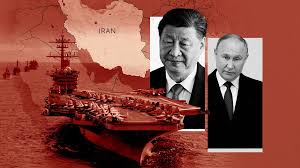
Russia and China Reject UN Resolution Aimed at Reopening Strait of Hormuz as Tensions Escalate
UNITED NATIONS-- Russia and China on Tuesday vetoed a U.N. Security Council resolution aimed at addressing the crisis in the Strait of Hormuz, rejecting a proposal that had been repeatedly scaled back in an effort to win their support or abstention.
The measure failed despite backing from a majority of the 15-member council, with the vote 11-2 and two abstentions from Pakistan and Colombia. The outcome underscored deep divisions among major powers as the conflict tied to Iran’s control of the strategic waterway entered its sixth week.
The vote came just hours after U.S. President Donald Trump escalated tensions further, warning that “a whole civilization will die tonight” if Iran did not reopen the strait and agree to terms before an 8 p.m. Eastern deadline. The Strait of Hormuz, a narrow passage between the Persian Gulf and the Gulf of Oman, carries roughly one-fifth of the world’s oil supply. Disruptions there have sent global energy prices sharply higher.
Russia and China defended their vetoes by pointing directly to Trump’s remarks, arguing the resolution risked enabling further military escalation by the United States and its allies.
Russia’s U.N. ambassador, Vassily Nebenzia, said the proposal would have effectively granted Washington and Israel “carte blanche for continued aggression.” China’s ambassador, Fu Cong, echoed that criticism, warning that the language of the draft could be “susceptible to misinterpretation or even abuse.”
Fu said the resolution failed to reflect what Beijing views as the underlying causes of the conflict, accusing the United States and its allies of precipitating the crisis. “The draft resolution, should it have been adopted, would send a wrong message and have serious, very serious consequences,” he said, adding that the situation risked further escalation amid what he described as open threats to “the very survival of a civilization.”
The resolution was introduced by Bahrain, which currently holds the rotating presidency of the Security Council and has been among Gulf nations most vocal in calling for international action. Following the vote, Bahrain’s foreign minister, Abdullatif bin Rashid Al Zayani, sharply criticized the council’s failure to act.
“Failing to adopt this resolution sends the wrong signal to the world,” Al Zayani said. “It sends the signal that the threat to international waterways can pass without any decisive action by the international organization responsible for the maintenance of international peace and security.” He accused Iran of effectively holding the global economy “hostage” through its actions in the strait.
Iran’s ambassador to the United Nations, Amir-Saeid Iravani, welcomed the vetoes and rejected the resolution’s characterization of Tehran’s conduct. He said Iran’s measures in the Strait of Hormuz were lawful and taken in self-defense under the U.N. Charter.
“The text unjustifiably and misleadingly portrays Iran’s lawful measures … as threats to international peace and security,” Iravani said.
Diplomats said the resolution’s chances of passage had diminished even before the vote, as successive revisions stripped out its most forceful provisions. An earlier draft would have authorized member states to use “all necessary means” — standard U.N. language that can include military force — to ensure safe passage through the strait and deter attempts to block it.
Facing opposition from veto-wielding members including Russia, China and France, negotiators softened the language to refer only to “defensive means necessary.” Subsequent revisions went further, removing any explicit Security Council authorization for action and narrowing the scope strictly to the Strait of Hormuz, rather than including adjacent waters.
The final text “strongly encourages” states with an interest in the waterway to coordinate defensive efforts to ensure safe navigation, including escorting commercial vessels and deterring interference with shipping. It also called on Iran to halt attacks on merchant vessels, cease obstruction of maritime traffic and stop targeting civilian infrastructure.
The United States, which had supported the resolution in its earlier and revised forms, criticized Russia and China for blocking the measure. U.S. Ambassador Mike Waltz said no country should tolerate threats to global commerce.
“No one should tolerate that they are holding the global economy at gunpoint,” Waltz said of Iran. “But today, Russia and China did tolerate it.” He accused them of siding with a government seeking to intimidate its neighbors while repressing its own population.
The confrontation at the United Nations comes amid widening regional fallout from the conflict. Since late February, Iran has launched strikes on targets including hotels, airports and residential buildings across more than 10 countries, including several Gulf states that are major exporters of oil and natural gas.
Gulf nations have increasingly described Iran’s actions in the strait as an existential threat, given their heavy reliance on energy exports that pass through the narrow corridor. Bahrain, which hosts the U.S. Navy’s Fifth Fleet, has taken a leading role in pushing for Security Council intervention.
Last month, the council adopted a separate Bahrain-sponsored resolution condemning what it called “egregious attacks” by Iran and demanding an immediate halt to strikes against regional targets. That measure passed 13-0, with Russia and China abstaining, and also called for an end to actions disrupting shipping in the Strait of Hormuz.
Diplomats say Tuesday’s veto highlights the limits of Security Council action in the face of geopolitical rivalries, even as the economic and security stakes tied to the strait continue to mount.