
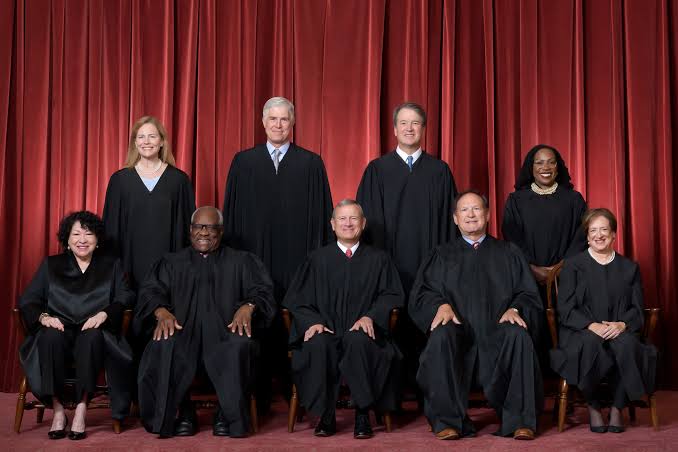
SCOTUS Upholds Birthright Citizenship, Rejects Trump's Executive Order in Landmark 6-3 Ruling
WASHINGTON-- The Supreme Court on Tuesday reaffirmed one of the nation's longest-standing constitutional principles, ruling 6-3 that the Fourteenth Amendment guarantees automatic U.S. citizenship to nearly every child born on American soil, delivering a major legal setback to President Donald Trump's effort to narrow birthright citizenship through executive action.
Chief Justice John Roberts authored the majority opinion, concluding that the Constitution's Citizenship Clause leaves little room for the interpretation advanced by the Trump administration and instead reflects more than a century of settled constitutional law.
The ruling strikes down an executive order Trump signed on the first day of his second term that sought to deny automatic citizenship to children born in the United States if their parents were either living in the country illegally or residing lawfully under temporary visas.
The order never took effect after federal judges at every level blocked its enforcement, with multiple courts concluding that it conflicted with the plain language of the Constitution. One federal judge described the policy as "blatantly unconstitutional," a conclusion that was ultimately affirmed by the nation's highest court.
Writing for the majority, Roberts pointed to the history and text of the Fourteenth Amendment, adopted in the aftermath of the Civil War to establish a clear national standard for citizenship. He wrote that the amendment's framers intentionally embraced broad language, rejecting proposals that would have imposed narrower limits on who qualified as an American citizen.
The amendment declares that "all persons born or naturalized in the United States, and subject to the jurisdiction thereof, are citizens of the United States and of the State wherein they reside."
Trump has long argued that the Citizenship Clause was intended only to secure citizenship for formerly enslaved people following the Civil War and was never designed to extend automatically to every child born within U.S. borders.
During his push to end birthright citizenship, Trump contended that the constitutional provision "wasn't meant for the entire world to occupy the United States."
That interpretation, however, has consistently been rejected by federal courts and stands in conflict with more than 160 years of constitutional precedent.
In explaining its decision, the Supreme Court relied heavily on its landmark 1898 ruling in United States v. Wong Kim Ark, the case that has served as the cornerstone of modern birthright citizenship doctrine.
Wong Kim Ark was born in San Francisco in 1873 to Chinese immigrant parents who operated a business in California before later returning to China. After traveling abroad to visit his family, he was denied reentry into the United States in 1895 after federal officials argued that he was not an American citizen.
He challenged the government's decision, and the Supreme Court ultimately ruled in his favor.
In that 6-3 decision, the justices held that nearly every child born on U.S. soil automatically acquires American citizenship under the Fourteenth Amendment. The Court recognized only a handful of narrow exceptions, most notably children born to accredited foreign diplomats, who are not considered fully subject to U.S. jurisdiction.
Tuesday's ruling reaffirmed that longstanding interpretation, emphasizing that the constitutional understanding established in Wong Kim Ark has remained firmly embedded in American law for well over a century.
The Court also noted that birthright citizenship endured even during periods of intense anti-immigrant sentiment. During World War II, for example, Japanese nationals detained in U.S. internment camps were classified as enemy aliens, yet children born to them on American soil were nonetheless recognized as U.S. citizens under the Fourteenth Amendment.
Congress later reinforced that interpretation by incorporating the constitutional understanding of birthright citizenship into federal law, further cementing the principle within the nation's immigration framework.
Representing the challengers was American Civil Liberties Union attorney Cecillia Wang, herself a birthright citizen born in the United States to Chinese immigrant parents. During oral arguments in April, Wang told the justices that the framers of the Fourteenth Amendment deliberately chose to make citizenship depend on the child's place of birth rather than the legal status of the parents.
The principle, she argued, reflected a broader constitutional commitment that children should not bear legal consequences for the actions or circumstances of their parents.
"When you're born in this country," Wang told the Court, "we're all American, all the same."
Justices Clarence Thomas, Neil Gorsuch and Samuel Alito dissented from the Court's decision.