
Trump Claims Gas Prices Will 'Return to Normal' in ‘a Few More Weeks,’ as His Own Energy Department Says to Expect Higher Prices Until 'At Least 2027'
WASHINGTON-- WASHINGTON-- President Donald Trump is projecting confidence that surging gas prices will soon fall back to normal levels, even as his own administration’s energy analyst warn that Americans could be paying elevated prices for years.
Speaking over the weekend, Trump said he expects fuel costs to “return to normal” within “a few more weeks” as the U.S. continues its military campaign against Iran. Other administration officials have echoed that optimism, framing the recent spike as a short-term consequence of the conflict.
“We think there’s a very good chance gas prices could dip below $3 a gallon by summer,” Energy Secretary Chris Wright said, describing the current surge as temporary.
But projections from the Energy Information Administration (EIA), which operates under the Department of Energy, suggest a far slower path to relief. In its latest outlook, the agency estimates that gasoline prices will remain above $3 per gallon through at least 2027, even under relatively stable conditions.
The conflicting messages come as the administration rolls out measures aimed at easing pressure on energy markets. On Wednesday, the White House announced a 60-day waiver of the Jones Act, a century-old shipping law that requires goods moved between U.S. ports to be carried on American-built and flagged vessels. The temporary waiver allows foreign ships to transport fuel domestically, a step officials say could help speed up deliveries and reduce costs.
“President Trump’s decision … is another step to mitigate short-term disruptions to the oil market,” White House press secretary Karoline Leavitt said, adding that the move will allow key resources like oil and natural gas to “flow freely” to U.S. ports.
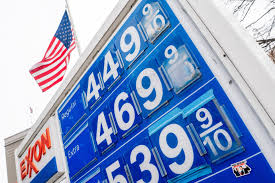
Still, many experts say the waiver is unlikely to meaningfully lower prices at the pump. Gasoline is currently averaging about $3.84 per gallon nationwide, according to AAA—up roughly 80 cents in just one month—as the war with Iran disrupts global supply chains.
At the center of the matter is the Strait of Hormuz, a critical chokepoint for global oil shipments that has been partially shut down during the conflict. A significant drop in gasoline prices would likely require both an end to hostilities and a full reopening of the route.
Even in that scenario, the EIA expects only gradual improvement. The agency now projects average U.S. gasoline prices of about $3.34 per gallon in 2026 and $3.18 in 2027—well above earlier forecasts made before the conflict began, when prices were expected to hover closer to $2.90.
The revised outlook reflects not only supply disruptions but also the time it will take to clear a growing backlog of oil tankers and repair damaged energy infrastructure in the region. Some estimates suggest it could take weeks just to normalize shipping traffic once the strait reopens.
The administration has also authorized the release of 172 million barrels of crude oil from the Strategic Petroleum Reserve as part of a broader effort to increase supply. National Economic Council Director Kevin Hassett said recent market signals point to a “rapid” end to the conflict and a corresponding drop in prices.
However, the EIA cautions that its projections remain highly uncertain and depend on several variables, including the duration of the war and how quickly oil producers in the Persian Gulf can resume normal operations.
For now, Americans are seeing the impact in real time, with gas prices climbing sharply and little immediate relief in sight—despite assurances from the White House that the spike will be short-lived.