
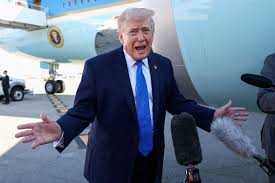
Trump Claims Peace Talks With Iran After Postponing Strike on Power Plant; Iran Denies Communication
WASHINGTON-- President Donald Trump said Monday that the United States is engaged in “very strong talks” with Iran aimed at ending the three-week war in the Middle East, and that senior adviser Steve Witkoff and his son-in-law, Jared Kushner, are leading the negotiations.
Trump said he would delay potential U.S. strikes on Iranian power plants for five days to allow time for diplomacy. Iran, however, publicly rejected the notion of progress, with its foreign ministry denying any direct talks with Washington.
U.S., Israeli and Iranian officials have repeatedly offered conflicting assessments of the conflict as each seeks to shape the narrative. Trump himself has issued shifting statements in recent days. On Saturday, he warned Iran he would order strikes on its power infrastructure within 48 hours unless Tehran reopened the Strait of Hormuz, a vital global oil route.
On Monday, Trump said the U.S. is in contact with an unnamed Iranian leader, pressing Tehran to halt nuclear enrichment and eliminate stockpiles of uranium that could be used for weapons. He declined to identify the official, saying only that it was not Iran’s newly installed supreme leader, Mojtaba Khamenei.
Israel did not immediately comment on the reported talks, and it remains unclear whether it would be bound by any agreement. Trump said Israeli officials had been briefed and would be “very happy” with the outcome.
Iran’s foreign ministry acknowledged regional efforts to ease tensions but dismissed Trump’s claims as an attempt to lower energy prices and “buy time” for potential military action, according to the state-run Mizan news agency.
Analysts say there is no clear path to ending the war, which began Feb. 28 and has expanded across the region. Despite Trump’s calls for regime change, Iran’s government remains in power, and much of its nuclear program appears intact.
Oman’s foreign minister said shortly before Trump’s announcement that his country is working to secure “safe passage arrangements” in the Strait of Hormuz, a key chokepoint through which about one-fifth of the world’s oil supply typically flows.
The conflict has driven global energy prices sharply higher, with oil and gas rising more than 50% since late February. The head of the International Energy Agency described the surge as more severe than the oil shocks of 1973 and 1979 combined. Iran has largely blocked Western and Arab oil shipments through the strait.
Following Trump’s remarks, Brent crude prices fell to about $100 a barrel after reaching $114 earlier in the day. It remains unclear whether the drop will hold without concrete progress toward a ceasefire.
More than 2,000 people have been killed since the conflict began, most in Iran and Lebanon, where Israel is also fighting Hezbollah, an Iran-backed militant group.