
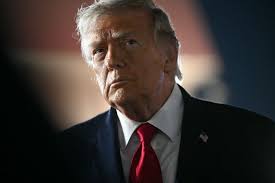
Trump Defends Allowing Iran to Keep Missile Stockpile, Defying Bipartisan Criticisms
PARIS — President Donald Trump on Wednesday defended the prospect of allowing Iran to retain a limited ballistic missile capability as part of an emerging agreement tied to the reopening of the strategically vital Strait of Hormuz, arguing that Tehran could not realistically be expected to possess no missiles while neighboring countries maintain their own arsenals.
Speaking during a news conference on the sidelines of the Group of Seven summit in France, Trump said the United States and its partners in the Persian Gulf would continue addressing a range of security concerns beyond Iran’s nuclear ambitions, including Tehran’s conventional missile program. However, he indicated that any final arrangement would not require Iran to completely eliminate every ballistic missile in its inventory.
“I mean, they have to have some, because other people have some. You got to have some,” Trump told reporters when pressed on the issue.
The remarks offered one of the clearest indications yet that the administration may be willing to accept a residual Iranian missile force as part of broader regional security negotiations, despite years of U.S. criticism of Tehran’s missile development efforts.
Trump pushed back against advisers and critics who have argued that Iran should be stripped of all missile capabilities.
“I like some of these guys, but I don’t think they’re smart,” Trump said, describing conversations with unnamed advisers. “‘Sir, you shouldn’t let them have any missile.’ I said, ‘Well, what am I going to do? Am I going to let Saudi Arabia have missiles, but they can’t have them?’ ‘Yes, sir.’”
The president’s comments come months after a U.S.-Israeli military campaign that targeted Iran’s missile infrastructure, production facilities and launch systems. The operation, which began Feb. 28, was aimed at degrading Tehran’s ability to manufacture and deploy ballistic missiles while also weakening what U.S. officials described as the protective framework surrounding Iran’s nuclear program.
Defense Secretary Pete Hegseth has repeatedly argued that the strikes delivered a devastating blow to Iran’s missile industry. While acknowledging that Tehran still possesses a portion of its missile stockpile, Hegseth has maintained that Iran’s ability to produce new ballistic missiles has been severely crippled.
In remarks made in mid-March, Hegseth asserted that every Iranian company involved in manufacturing key ballistic missile components had effectively been destroyed during the campaign.
He has also contended that Iran viewed its missile force as a strategic shield designed to deter attacks on its nuclear facilities, making missile launchers, production centers and related infrastructure priority targets during the joint military operation.
Trump appeared to downplay the broader threat posed by conventional missiles when discussing the negotiations.
“Doesn’t work that way, you know, it doesn’t work that way, and missiles aren’t the problem,” the president said. “Missiles, they hurt a little location, but they don’t blow up the planet.”
The issue has remained one of the most contentious subjects in ongoing talks. Iranian officials have repeatedly identified restrictions on their missile program as a non-negotiable red line, insisting that the country has the right to maintain conventional defensive capabilities.
Iran has relied heavily on its missile arsenal in recent months, launching strikes against U.S. military installations in the Persian Gulf as well as targets inside Israel during periods of heightened regional tensions.
Asked later in the news conference why Iran should be permitted to retain any missile capability at all, Trump argued that the country’s remaining arsenal has already been dramatically reduced and poses a diminished threat.
“We knocked out probably 84, 85 percent of their missiles,” Trump said. “The rest of them are underground; they can’t even get them out, you know.”
The president’s assessment differs from some intelligence estimates. According to a report published by The New York Times in mid-May, U.S. intelligence agencies concluded that Iran retained roughly 70% of its mobile missile launchers and about 70% of its prewar missile inventory, including both ballistic and cruise missiles.
Even so, Trump insisted that Tehran’s ability to replenish its forces has been severely impaired by the military campaign and subsequent economic pressures.
“They don’t want to be firing missiles right now,” Trump said. “They’re going to have a hard time rebuilding. They’re going to have a hard time rebuilding.”
The debate over Iran’s remaining missile capabilities is expected to remain a central issue as negotiators work toward a broader agreement aimed at reducing regional tensions, securing maritime trade routes and preventing further escalation in the Middle East.