
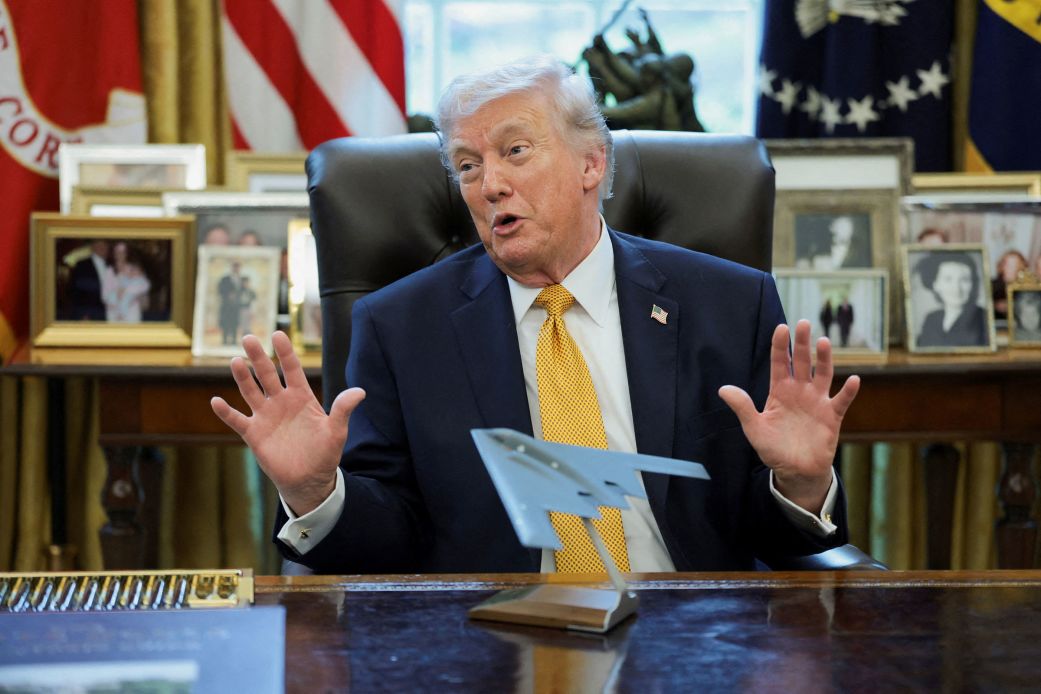
Trump Stuns Financial Experts, and Voters, With Confusing 'All is Well' Commentary on Economy
WASHINGTON-- After initially framing the economic impact of the conflict with Iran as a case of short-term sacrifice for longer-term benefit, President Donald Trump and his advisers have increasingly shifted to a more optimistic message about current conditions — one that contrasts with what many Americans report experiencing.
In recent appearances, Trump has emphasized positive indicators such as stock market performance while downplaying concerns about rising costs, including fuel prices and inflation.
“To be honest, we are doing so well,” Trump said in an interview with Fox Business host Maria Bartiromo that aired Wednesday, pointing to market resilience. When pressed on oil prices hovering around $92 per barrel, Trump suggested the figure was acceptable compared to earlier projections that prices could reach $200. “I’m very happy,” he said.
The president reiterated similar points Thursday during remarks outside the White House and at a campaign event in Las Vegas focused on tax policy. He described inflation as “a very low number,” despite recent data showing it climbed to a two-year high last month, with analysts توقعing further increases tied to the war’s economic effects. Trump also referred to what he called “our great economy.”
Addressing concerns about gasoline prices nearing $4 per gallon in some areas, Trump again cited broader economic indicators. “Everything’s doing really well,” he said, adding that prices were “not very high” compared to earlier expectations. Just weeks before the conflict escalated, Energy Secretary Chris Wright had suggested there was “a very good chance” gas prices would fall below $3 per gallon by summer.
Trump has also attributed inflation primarily to rising energy costs, at one point calling broader inflation concerns “fake.” He contrasted current conditions with his first term, saying, “We had the best economy in the history of our country… and we’re blowing it out now.”
Other administration officials have echoed that assessment. White House press secretary Karoline Leavitt said during a recent briefing that Americans should consider year-over-year declines in gas prices since Trump took office. According to GasBuddy data, average prices were about $3.11 per gallon at the time of his inauguration and had fallen modestly before the onset of the war.
Treasury Secretary Scott Bessent has also described the economy as strong, arguing in interviews that underlying conditions supported the administration’s ability to engage in the conflict. In a CNBC appearance, he said the economy was in “such good shape,” and in a Tax Day interview with the National News Desk, he suggested Americans may feel more confident than surveys indicate.
“The consumer, while they may be sounding grim, is actually quite buoyant,” Bessent said, citing continued spending. He later added that despite negative responses in surveys, “in their heart of hearts, they feel good.”
Some economists have noted that certain fundamentals, including consumer spending and stock market recovery after early war-related losses, remain relatively stable. Similar arguments were made by the Biden administration after inflation began easing, though public perceptions of the economy remained negative during that period.
Recent data highlights that disconnect. The University of Michigan’s consumer sentiment index fell to its lowest level on record, with data spanning back to the years following World War II. The reading is below levels seen during the post-pandemic inflation surge, the Great Recession and other periods of economic strain.
Polling reflects similar concerns. A CNN survey conducted in late March found that 23% of Americans rated the economy as at least “somewhat good,” near the lowest levels recorded in recent years. The poll also found that 62% expected economic conditions to remain poor over the next year, while more than 60% said rising gas prices posed at least a moderate hardship and reported adjusting their spending habits.
Additionally, respondents said by a margin of 65% to 25% that Trump’s policies had worsened economic conditions rather than improved them. That gap has widened since January, when the same measure stood at minus-23 points.
As the conflict continues, the divergence between the administration’s economic messaging and public sentiment remains a central challenge, particularly as higher prices and uncertainty persist.