
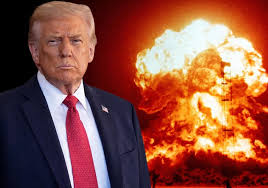
Trump Threatens "Whole Civilization Will Die Tonight" as Iran Negotiations Meet Final Hours
WASHINGTON-- President Donald Trump on Tuesday dramatically escalated his rhetoric toward Iran, warning that “a whole civilization will die tonight” unless Tehran agrees to terms that include reopening the critical Strait of Hormuz, a key artery for global oil shipments.
The stark warning followed overnight U.S. strikes on military targets on Kharg Island, Iran’s primary oil export terminal, according to a White House official who spoke to CNBC. The strikes marked a significant expansion of U.S. operations tied to the ongoing conflict involving Iran and Israel, now entering its second month.
“A whole civilization will die tonight, never to be brought back again. I don’t want that to happen, but it probably will,” Trump wrote Tuesday morning on his Truth Social platform.
He added a note of uncertainty about Iran’s political future, suggesting that recent upheaval could create an opening for change. “However, now that we have complete and total regime change, where different, smarter, and less radicalized minds prevail, maybe something revolutionarily wonderful can happen — who knows?” Trump wrote. “We will find out tonight, one of the most important moments in the long and complex history of the world.”
The Strait of Hormuz, through which roughly a fifth of the world’s oil supply typically flows, has been largely փակ since late February, when hostilities between U.S., Israeli and Iranian forces intensified. Iran’s restriction of maritime traffic through the narrow waterway has triggered a sharp global energy shock, sending oil prices surging and raising concerns about broader economic fallout.
Despite repeated claims from Trump that Iran’s military capabilities have been “obliterated,” administration officials acknowledge Tehran retains the ability to disrupt shipping through the strait — a key source of leverage in ongoing negotiations.
Trump has paired his warnings with increasingly aggressive language in recent days. In a social media post over the Easter weekend, he threatened to target Iran’s infrastructure, including bridges and power plants, if its leadership failed to comply with U.S. demands. He later set an 8 p.m. Eastern deadline on Tuesday for Iran to respond.
The White House did not immediately respond to requests for comment on Trump’s latest remarks.
Speaking at a White House news conference Monday, Trump said any agreement to avert further escalation would need to meet his conditions, including guaranteeing the free flow of oil through the strait. He has criticized Iran’s suggestion that it could impose tolls on shipping and has floated the idea of the United States asserting control over transit terms.
Diplomatic efforts have continued behind the scenes, with U.S. officials, Iranian representatives and regional mediators weighing a proposed 45-day ceasefire as a potential off-ramp. But administration officials indicated Trump has not endorsed the proposal, and Iranian leaders have rejected temporary measures, instead calling for a comprehensive agreement to end the conflict.
“The only one that’s going to set a ceasefire is me,” Trump said Monday when asked about the proposal during the White House Easter Egg Roll.
Vice President JD Vance, speaking Tuesday in Budapest during a visit to support Hungarian Prime Minister Viktor Orbán, defended the administration’s approach and reiterated the urgency of the timeline.
“The deadline is eight o’clock,” Vance said. “What Iran is trying to do, because they’ve been defeated militarily, is extract as much economic pain on the world as possible. And the president of the United States is a man who recognizes leverage.”
Trump has also argued that continued U.S. military pressure aligns with the desires of the Iranian public, asserting — without providing evidence — that civilians have privately urged Washington to sustain its campaign despite the risks.
“They would be willing to suffer that in order to have freedom,” Trump said Monday. “We’ve had numerous intercepts: ‘Please keep bombing.’ Bombs that are dropping near their homes — ‘please keep bombing.’”
At the same time, Trump has suggested that Iran’s newly installed leadership — following the deaths of several top officials in recent strikes — may be more open to negotiation.
That assessment is disputed by some analysts. In a note to clients Monday, JPMorgan researchers said the conflict appears to have strengthened hardline elements within Iran, particularly the Islamic Revolutionary Guard Corps, and warned that Tehran’s strategy is likely focused on endurance rather than immediate concessions.
“Iran may have lost its supreme leader and commanders, and suffered severe damage to nuclear facilities and military assets, but there are no signs of capitulation,” the analysts wrote.
With hours remaining before Trump’s self-imposed deadline, the situation remains highly volatile, with global markets, regional governments and military planners closely watching whether diplomacy can avert further escalation.