
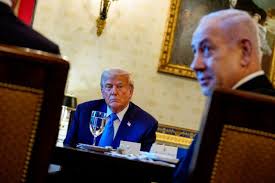
Trump Turns on Netanyahu as Deal Plays Out With Iran
WASHINGTON — The political alliance between President Donald Trump and Israeli Prime Minister Benjamin Netanyahu has long been viewed as one of the closest relationships between an American president and an Israeli leader in modern history. Netanyahu himself once praised Trump as the “greatest friend Israel ever had in the White House.”
But as Trump races to secure a diplomatic agreement aimed at ending the conflict with Iran and reopening the Strait of Hormuz, the once-solid partnership appears to be under unprecedented strain. In recent days, Trump has delivered some of the sharpest public criticism ever directed at Netanyahu by a sitting U.S. president, signaling growing frustration with the Israeli leader at a pivotal moment in Middle East diplomacy.
The unusually blunt remarks have stunned political observers in both Washington and Jerusalem, where disagreements between U.S. and Israeli leaders are common behind closed doors but are rarely aired so openly in public.
Trump has not only questioned Netanyahu’s recent decisions but has also sought to underscore the extent of American support for Israel, suggesting that his own actions as president were indispensable to the country’s security and standing on the world stage.
“Without the U.S., there would be no Israel. Without me, there would be no Israel because no other president was willing to do what I did,” Trump said Tuesday while attending the annual Group of Seven summit in France.
The president went on to acknowledge his historically close relationship with Netanyahu, whom he often refers to by his nickname, “Bibi,” but made clear that he believes the Israeli prime minister has crossed a line with recent military actions.
“I have had a great relationship with Bibi,” Trump said. “Now Bibi has to be more responsible with respect to Lebanon.”
The comments followed reports that Trump privately expressed anger over recent Israeli strikes in Lebanon, operations that administration officials fear could complicate delicate negotiations between Washington and Tehran. The White House has invested significant political capital in securing a broader agreement with Iran, and any escalation elsewhere in the region threatens to derail months of diplomatic efforts.
According to analysts, Trump’s increasingly public frustration reflects a growing determination to prevent events on the ground from interfering with an agreement he views as one of the most consequential foreign policy achievements of his presidency.
Aaron David Miller, a veteran Middle East adviser who served both Democratic and Republican administrations over more than two decades, said Trump appears willing to use the considerable leverage the United States holds over Israel if Netanyahu stands in the way of a negotiated settlement.
“If Netanyahu gets in between something Trump really wants, and that’s out of this war, he’s prepared to use the leverage that he has,” Miller said.
The dispute comes at a politically sensitive moment for Trump. The conflict with Iran has generated increasing criticism at home, where polls indicate war fatigue among voters and concerns over rising energy prices. The fighting contributed to a sharp increase in global oil prices, driving up gasoline costs and creating additional economic pressure for American consumers.
Administration officials hope a memorandum of understanding with Iran, expected to be signed Friday at the Burgenstock resort near Luzern, will stabilize regional tensions and help ease pressure on energy markets.
Trump’s criticism of Netanyahu marks a notable departure from the posture he maintained throughout much of his political career. During his first administration, Trump pursued a series of policies strongly favored by the Israeli government, including relocating the U.S. Embassy from Tel Aviv to Jerusalem, recognizing Israeli sovereignty over the Golan Heights and brokering normalization agreements between Israel and several Arab nations through the Abraham Accords.
Those actions earned Trump widespread praise from Netanyahu and many pro-Israel organizations, making the current tensions all the more striking.
The dispute also highlights broader changes in American politics surrounding Israel. For decades, support for Israel was largely a bipartisan consensus in Washington. In recent years, however, that consensus has weakened as political divisions over the Israeli-Palestinian conflict have deepened.
Many progressives have become increasingly critical of Israeli policies toward Palestinians, particularly during the war in Gaza, while some conservatives have questioned the extent of American commitments abroad and the strategic value of unconditional support for foreign allies.
At the same time, concerns about antisemitism have emerged across the political spectrum, adding another layer of complexity to debates over U.S.-Israel relations.
Trump’s latest comments quickly drew criticism from some Jewish and Democratic advocacy groups, which argued that his characterization of Israel’s existence was inappropriate and historically inaccurate.
Halie Soifer, executive director of the Jewish Democratic Council of America, said Trump’s remarks went beyond ordinary political criticism.
“He is framing Israel’s mere existence as contingent on him,” Soifer said. “It’s deeply offensive to the vast majority of Jews who care about Israel’s future.”
The response underscores how discussions about Israel remain politically charged in the United States, particularly when they involve questions of American influence and support.
The contrast between Trump’s rhetoric and that of former President Joe Biden has also attracted attention.
Biden and Vice President Kamala Harris frequently clashed with Netanyahu during the war in Gaza and occasionally voiced their disagreements publicly. However, they generally sought to balance criticism of Israeli government policies with strong affirmations of support for Israel’s security, partly to avoid accusations that they were undermining a key U.S. ally.
Trump, by contrast, has demonstrated a greater willingness to publicly confront Netanyahu despite his long record of support for Israel.
Some pro-Israel conservatives have argued that Trump’s criticism should not be interpreted as a fundamental shift in policy.
Matt Brooks, president of the Republican Jewish Coalition, characterized the dispute as a disagreement between close allies rather than a rupture in the relationship.
Brooks said Trump’s extensive record of support for Israel gives him a level of credibility with pro-Israel voters that previous Democratic administrations often lacked.
“If Biden or Harris said something critical, it came from the position of someone who was hostile toward or didn’t have the same level of support for Israel that President Trump has,” Brooks said.
Brooks pointed to several actions by Trump that remain highly popular among many supporters of Israel, including the embassy relocation to Jerusalem and efforts to secure the release of Israeli hostages held in Gaza during his second term.
In his view, Trump’s criticism carries less political risk because it is backed by years of policies widely viewed by Israeli supporters as beneficial to the Jewish state.
Others within the pro-Israel movement are less comfortable with the president’s decision to air his frustrations publicly.
Mort Klein, president of the conservative Zionist Organization of America, said disagreements between allies are inevitable but argued they are better handled behind closed doors.
Klein expressed concern that Trump’s remarks could inadvertently weaken support for Israel at a time when public opinion in the United States appears increasingly divided.
He also noted what he sees as a contrast between Trump’s harsh criticism of Netanyahu and the president’s often positive comments about authoritarian leaders in countries such as Turkey, China and North Korea.
Klein questioned whether Trump’s public criticism was partly influenced by changing political attitudes among American voters.
“He sees that Americans have become more hostile toward Israel than they’ve ever been,” Klein said. “That worries me.”
As negotiations with Iran enter their final stages, the friction between Trump and Netanyahu is emerging as one of the most closely watched dynamics in international diplomacy. Whether the disagreement proves to be a temporary dispute between longtime allies or the beginning of a more significant rift could have major implications for both U.S.-Israeli relations and efforts to stabilize the Middle East after months of conflict.
For now, Trump appears determined to secure a diplomatic breakthrough, even if doing so means publicly challenging one of Washington’s closest allies—and one of the foreign leaders with whom he has historically enjoyed one of his strongest political relationships.