
US Oil Prices Rise Again as Iran War Reignites
WASHINGTON-- Oil prices surged Wednesday as renewed fighting between the United States and Iran rattled global energy markets, fueling concerns that escalating violence in the Persian Gulf could further disrupt crude shipments and push fuel costs higher for consumers.
U.S. benchmark West Texas Intermediate (WTI) crude climbed to roughly $79 per barrel Tuesday, marking a sharp increase from about $74 at the start of trading Monday and approximately $72 late last week. International benchmark Brent crude followed a similar trajectory, rising to about $85 per barrel after trading near $79 early Monday and around $76 at the close of last week.
Energy analysts say the latest price spike reflects growing fears that military action in and around the Strait of Hormuz could significantly restrict the flow of oil from one of the world's most critical energy corridors.
"The oil market is reacting to first the Iranian attacks on oil tankers over the weekend, as well as one early this morning, and the subsequent retaliation by the United States attacking facilities in Iran," said Andy Lipow, president of Lipow Oil Associates.
Lipow said continued attacks on commercial vessels are raising the risks for shipping companies operating in the region.
"Continuing attacks like this on tankers is going to reduce the tanker traffic as the risk of being targeted and hit by a missile or drone increases, and so the oil market is reacting accordingly, and we're seeing higher prices," he said.
The Strait of Hormuz, located between Iran and Oman, remains one of the world's most strategically important maritime chokepoints. Before hostilities intensified earlier this year, roughly one-fifth of the world's oil supply passed through the narrow waterway each day.
The passage briefly reopened after Washington and Tehran reached a ceasefire agreement earlier this year, easing concerns about global supply. But the collapse of that agreement and a renewed exchange of military strikes have once again cast uncertainty over commercial shipping in the region.
"The ship owners are moving back to the sidelines and holding pending new information that maybe it can be safe again," said Clay Seigle, a nonresident scholar in energy security at the Center for Strategic and International Studies.
"The most recent activity is serious military attacks on ships," Seigle said.
While some operators are still willing to transit the waterway, overall traffic has slowed considerably, he said.
"I do think that there will be some risk-tolerant actors that continue to go for it, but it's slowing to a trickle," Seigle said.
He added that the deteriorating security situation has implications extending well beyond the oil market.
"That's the headline for the oil market and for those that are concerned about the economy and the prospect for inflation to be rekindled," Seigle said.
The latest escalation began over the weekend when Iran launched an attack on a commercial vessel transiting the Strait of Hormuz. The United States responded with strikes on Iranian facilities, and both countries have continued exchanging military attacks in the days since.
Iran also launched strikes against other countries in the region, including Jordan and Qatar. The United Arab Emirates said Monday that Iranian forces struck one of its tankers, killing a crew member.
Military operations continued into Tuesday, heightening concerns that the conflict could spread further across the region.
President Donald Trump announced Monday that the United States would establish a blockade of the Strait of Hormuz, arguing that the U.S. should serve as the "guardian" of the vital shipping lane.
Trump initially proposed imposing a 20% toll on vessels leaving the strait but later reversed course.
"Based on highly productive conversations with Middle East leadership, I have decided to replace the 20% United States Reimbursement Fee with Trade and Investment Deals that the various Gulf States will be making into the United States," Trump wrote on Truth Social.
"Those Investments will be MASSIVE but, at the same time, extraordinarily good for them, and their future."
The renewed fighting has already begun affecting maritime traffic through the strait.
According to vessel-tracking service MarineTraffic.com, confirmed crossings through the Strait of Hormuz fell by approximately 52% between Friday and Sunday compared with the previous week. Preliminary data showed traffic continued declining Monday as shipping companies reassessed the risks of operating in the area.
A sustained reduction in tanker traffic could tighten global crude supplies even further if shipping companies continue delaying voyages or rerouting vessels.
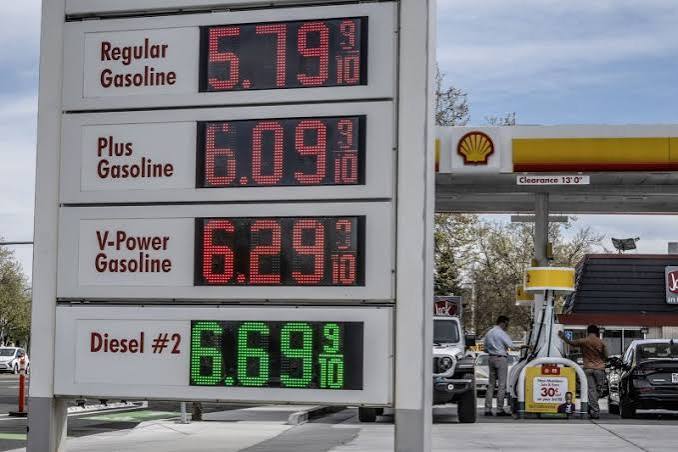
Lipow warned that the increase in crude prices is likely to translate into higher costs for American drivers in the coming days.
"Gasoline prices are expected to go back above $4 a gallon and diesel prices are going to head back to over $5 a gallon over the next seven to 10 days," he said.
According to AAA, the national average price for a gallon of regular gasoline stood at approximately $3.86 on Tuesday, though analysts say prices could climb quickly if tensions continue to escalate and oil shipments through the Strait of Hormuz remain disrupted.