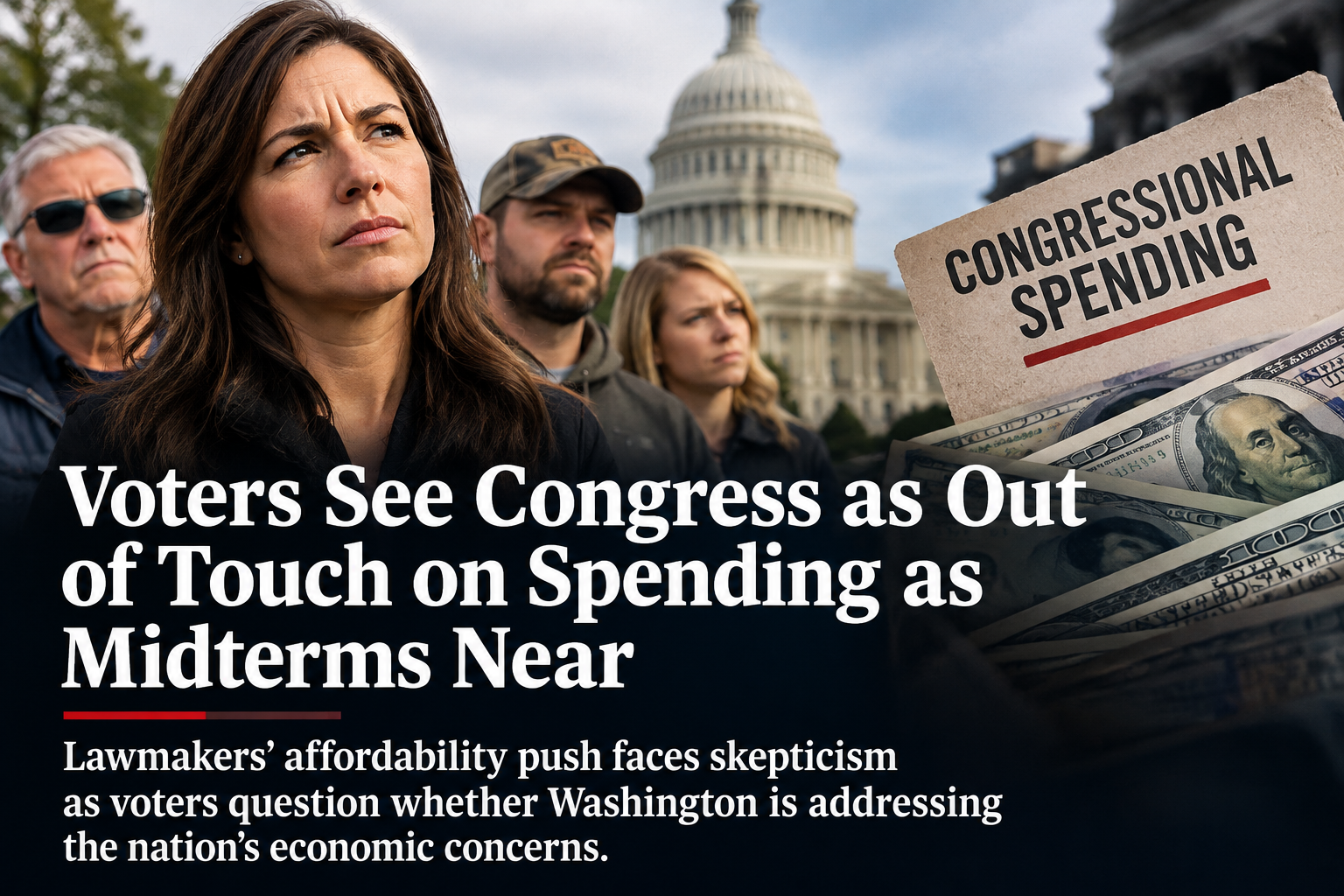
Voters See Congress as Out of Touch on Affordability Crisis as Midterms Draw Near
WASHINGTON-- With the 2026 midterm elections approaching, affordability concerns remain at the forefront of voters’ priorities, with health care expenses and gasoline prices emerging as leading economic worries, according to a new KFF Health Tracking Poll. The findings highlight the political challenges facing candidates as they make their final appeals to voters, many of whom continue to grapple with the rising cost of everyday necessities and uncertainty over future medical expenses.
The survey finds that voters place significant emphasis on the cost of living and health care, with broad majorities saying these issues should be central to candidates’ campaigns during the final weeks before Election Day. The poll also reveals a partisan divide over which party voters trust to address these concerns, with Democrats maintaining a substantial advantage over Republicans on health care costs and a smaller but notable lead on the overall cost of living.
According to the poll, one-quarter of voters say they are “very worried” about their ability to afford health care and gasoline or transportation costs, with both concerns registering at 25%. An additional 35% say they are “somewhat worried” about health care expenses, while 34% express similar concerns about gas and transportation costs.
These concerns exceed voters’ reported worries about the affordability of food, utilities and housing, underscoring the pressure that essential expenses continue to place on household budgets. The findings suggest that the financial strain associated with routine living expenses, combined with the potentially unpredictable cost of medical care, could play an influential role in shaping voter attitudes as the midterm campaigns enter their final stretch.
The importance voters attach to these issues is particularly pronounced. Nine in 10 voters, or 90%, say the cost of living is “very” or “extremely” important for candidates to discuss. Another 82% say the same about health care costs, indicating that candidates who fail to address affordability could risk overlooking issues that matter deeply to the electorate.
“Of all the cost-of-living worries hitting voters now, a big health care bill is the least predictable, and that’s a big reason why health care costs are right up there with gas prices and the costs of food and housing on voters’ minds,” KFF President and CEO Dr. Drew Altman said.
The poll also points to a growing advantage for Democrats on health care, an issue that has become an increasingly prominent dividing line between the parties. Forty-two percent of voters say they trust Democrats more than Republicans to handle health care costs, compared with 22% who favor Republicans. That 20-percentage-point gap represents a significant shift from April, when Democrats held an 11-point advantage, with 37% trusting Democrats and 26% favoring Republicans.
Democrats also maintain an advantage on the broader issue of affordability. Thirty-nine percent of voters say they trust Democrats more to handle the cost of living, compared with 25% who say they have greater confidence in Republicans.
The parties’ standing varies on other major campaign issues. Democrats hold an advantage over Republicans on abortion policy, with 42% of voters expressing greater trust in Democrats and 27% favoring Republicans. Immigration and fraud in government programs, however, remain more competitive issues. On immigration, 38% trust Republicans more, compared with 34% who favor Democrats. On fraud in government programs, Republicans hold a narrower advantage, with 31% trusting them more and 29% favoring Democrats.
Among independent voters, Democrats hold particularly large advantages on several issues central to the campaign. Thirty-eight percent of independents say they trust Democrats more than Republicans to address health care costs, compared with just 9% who favor Republicans. On the cost of living, Democrats lead 35% to 11%. Democrats also hold a substantial advantage on abortion policy among independents, with 42% expressing greater trust in Democrats and 14% favoring Republicans.
Despite those advantages, the poll finds that sizable shares of independent voters remain reluctant to place their confidence in either party on many of the issues shaping the midterm debate. That hesitation could complicate both parties’ efforts to persuade voters who remain dissatisfied with the political establishment and uncertain about whether elected officials can deliver meaningful economic relief.
The survey also identifies a difference in voter enthusiasm between the parties. Nearly two-thirds of Democratic voters, 63%, say they are more motivated to vote in this year’s election than they were in previous elections. By comparison, 38% of Republican voters report feeling more motivated.
A majority of Republican voters, 53%, say their motivation is about the same as in previous elections. Independent voters are more evenly divided, with 41% saying they are more motivated to vote and 44% reporting about the same level of motivation as in previous elections.
The enthusiasm gap could become a factor in closely contested races, where turnout among party supporters and the ability to attract undecided voters can influence the outcome. However, the poll measures voters’ stated motivation rather than actual turnout, leaving open the question of whether the reported differences will translate into voting behavior.
Broad agreement that health care needs reform
Beyond the immediate concerns over affordability, the poll finds widespread bipartisan dissatisfaction with the U.S. health care system. Nearly nine in 10 Democrats, or 89%, say the system needs either a complete overhaul or major changes. Among Republicans, 77% express the same view.
The findings suggest that frustration with the health care system extends well beyond one political party, even as Democrats and Republicans disagree over the policies that should be adopted to address its shortcomings. Rising medical expenses, insurance costs and concerns about access to care have helped place health care reform back at the center of the political debate.
In several midterm contests, progressive Democratic candidates have responded to voters’ concerns by advocating the creation of a national health plan, commonly known as “Medicare-for-All.” The proposal has drawn criticism from Republican opponents, who have raised concerns about its potential costs, tax implications and effects on the existing health care system.
Nevertheless, public support for a national health plan has reached its highest level since KFF began tracking the issue in 2016, when Sen. Bernie Sanders made the proposal a central element of his presidential campaign.
The latest poll finds that 66% of the public supports a national health plan, an increase that places the proposal at a record high in KFF’s polling on the subject. Support is strongest among Democrats, 84% of whom favor the idea, and independents, 72% of whom express support. Republicans remain largely opposed, with 66% saying they oppose such a plan.
KFF has tracked public opinion on Medicare-for-All and other proposals for a national health plan since the late 1990s. Its findings have repeatedly shown that attitudes toward major health care policy changes can shift considerably depending on how proposals are presented and what information voters receive about their potential benefits and drawbacks.
The latest results illustrate that sensitivity. Although support for a national health plan stands at 66% when the proposal is presented more generally, it declines sharply when respondents are told about potential disadvantages.
When voters are told that Medicare-for-All could result in delays for medical tests and treatments, support falls to 24%. It drops to 35% when respondents are told the plan could require tax increases and to 38% when they are told it could threaten the existing Medicare program.
Conversely, support rises when the proposal is framed around potential benefits. Approximately three-quarters of respondents favor a national health plan when told it would make health insurance a right, with support reaching 76%. Support also rises to 75% when respondents are told the plan would eliminate health insurance premiums and cost-sharing.
The contrasting results underscore how the political debate over Medicare-for-All could influence public opinion as candidates make their cases to voters. Support for the concept remains substantial, but concerns about taxes, access to treatment and the future of existing coverage could create vulnerabilities for candidates who endorse the proposal.
The findings also highlight a broader challenge for both parties heading into the midterms: Voters broadly agree that health care costs and the cost of living deserve urgent attention, but they remain divided over which party is best equipped to address those problems and what policy changes would provide meaningful relief.
With affordability continuing to dominate voters’ concerns, the ability of candidates to offer credible responses to rising expenses could prove consequential in the closing weeks of the campaign. For Democrats, the growing advantage on health care costs and the record level of support for a national health plan offer potential political openings. For Republicans, the findings point to the need to address voters’ economic anxieties while making the case for their own approach to health care and government spending.
The extent to which those competing messages influence turnout and voter preferences will become clearer as Election Day approaches.